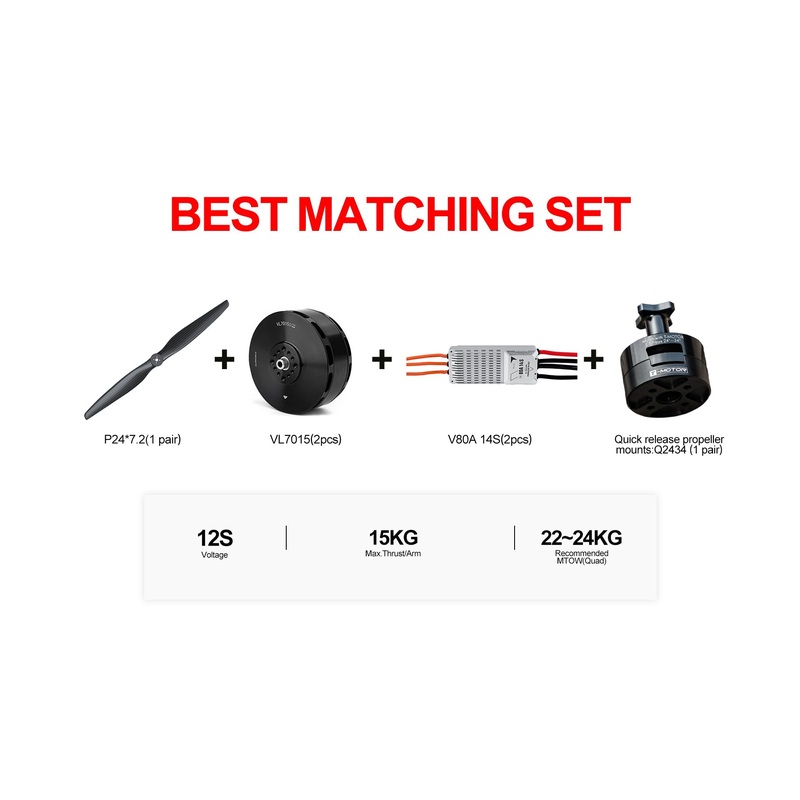
VL7015 Power System for VTOL Drones
Core Overview
The VL7015 is a member of the T-MOTOR VL series power system, specifically designed for the rotor power needs of Vertical Take-Off and Landing (VTOL) unmanned aerial vehicles. The kit, in a quadrotor configuration, is recommended for a takeoff weight of 22~24kg, with a maximum single-axis thrust of 15.8kg. It provides stable, intelligent vertical takeoff and landing power for VTOL fixed-wing or multi-rotor drones, ensuring flight safety throughout all phases from takeoff, mode transition, to landing.
Core Technology Advantages
Built for VTOL Fixed-Wing: Mag-Coded Prop Braking, Energy-Saving, Reliable
Fast (Second-Level Braking): Supports 360 customizable angle propeller braking, effectively avoiding airflow disturbance caused by rotor rotation, ensuring the aerodynamic layout of the fixed-wing aircraft is unaffected, thereby enhancing flight safety.
Economical (Adaptive Braking): According to changes in external force, the ESC automatically adjusts the current to control the braking torque, reducing power consumption and heat generation, achieving energy-saving effects.
FOC Vector Control
Adopts FOC (Field-Oriented Control) technology, achieving more delicate and precise control, thereby ensuring highly stable power output, offering comprehensive advantages of responsive, precise control, efficient drive, and low-noise operation.
Small Thrust Drop Ratio Under Voltage Drop
In the face of voltage drop, it can maintain small thrust fluctuations, demonstrating excellent stability. This keeps the throttle increase amplitude at a lower level, thus providing larger control redundancy, significantly improving safety during landing.
Supports CAN2.0 Protocol, Intelligent and Convenient
Plug and Play: This ESC supports the DroneCAN/CAN2.0 protocol, fully compatible with the PX4 flight control system, offering plug-and-play convenience.
Remote Monitoring: Remote real-time monitoring of the ESC’s working status through the flight control system ensures the system is always in optimal working condition.
Usage Recommendations
- Accurate Model and Weight Matching: This kit is designed for VTOL drones. In a quadrotor configuration, strictly control the entire aircraft’s takeoff weight within the recommended range of 22~24kg to match its single-axis maximum thrust of 15.8kg and ensure a safety margin.
- Must Use CAN Bus Connection: To obtain all intelligent functions such as remote monitoring and fast propeller braking, it is necessary to use the CAN bus to connect to a flight controller (such as PX4) that supports the DroneCAN/CAN2.0 protocol. PWM mode can be used as a backup.
- Pay Attention to Cooling Conditions: Both the “Maximum Current (10s) 80A” and “Maximum Continuous Current 40A” in the ESC parameters are marked as achieved “under certain cooling conditions.” Ensure the power system is installed in a well-ventilated location within the aircraft; otherwise, continuous performance will be compromised, and lifespan will be affected.
- Make Good Use of Propeller Braking: For VTOL fixed-wing aircraft, make full use of its 360 propeller braking function. After transitioning to fixed-wing mode, locking the propellers in the direction of least drag can significantly improve aerodynamic efficiency and endurance.
Product Parameters
Basic Parameters
| Parameter Item | Parameter Value |
|---|---|
| Motor Model | VL7015 |
| Magnet Temperature Rating | 180 |
| Motor Dimensions | 79.2 * 44.4mm |
| Wire Gauge * Length | Silicone Wire 14# 600mm |
| Stator Process | 150 High-Temperature Coating |
| Enameled Wire Temp. Rating | 220 |
| Slot/Pole Count | 24N28P |
| Coil Withstand Voltage | 1000V/5s |
| Shaft Diameter | IN:8mm OUT:8mm |
| Rotor Dynamic Balance Standard | 10mg |
| Bearing Model | Imported 608 Bearing |
| Protection Level | IP25 |
| Centrifugal Cooling | Yes |
| Package Dimensions | 158 * 135 * 64mm |
| Model | VL7015 |
| KV (RPM/V) | 190 |
| Recommended Battery | 12S |
| No-load Current (15V) | 2.0A |
| Internal Resistance (25) | 35m |
| Maximum Current | 85A |
| Maximum Continuous Power | 1068W |
| Operating Environment Temp. | -30~55 |
| Maximum Thrust | 15.8kg |
| Motor Weight (with wires) | 540g |
ESC Parameters
| Parameter Item | Parameter Value |
|---|---|
| Model | V80A |
| Maximum Voltage | 60V |
| Maximum Current (10s) | 80A (under certain cooling conditions) |
| Maximum Continuous Current | 40A (under certain cooling conditions) |
| Standby Power Consumption | 50mA |
| Throttle Range | 1040~1940us (Fixed) |
| Throttle Response Time | 300ms |
| Control Method | PWM / CAN |
| Communication Method | DRONE CAN / UAV CAN |
| Propeller Braking Method | Electronic Braking |
| Encoder Wire | -45010mm-M6 Aviation Plug |
| Output Wire | Silicone Wire-Orange-14AWG-110 10mm |
| Input Wire | Silicone Wire-Red/Black-12AWG -18010mm |
| Signal Wire | -45010mm-JP-3P*2 Black White Green Yellow Gray |
| Weight (with wires) | 110g |
Propeller Parameters
| Parameter Item | Parameter Value |
|---|---|
| Model | P24 * 7.2 inch (610 * 198.1mm) |
| Weight | 605g |
VL7015 Kit Test Data Tables
VL7015 Kit Test Data (KV190 + V80A 14S + P24 * 7.2, Test Voltage 44.4V)
| Throttle | Voltage (V) | Thrust (g) | Torque (N*m) | Current (A) | RPM | Power (W) | Efficiency (g/W) | Motor Temp. () |
|---|---|---|---|---|---|---|---|---|
| 40% | 44.31 | 2639 | 0.71 | 6.70 | 2975 | 297 | 8.88 | |
| 42% | 44.30 | 2915 | 0.78 | 7.64 | 3128 | 338 | 8.61 | |
| 44% | 44.28 | 3232 | 0.86 | 8.72 | 3276 | 386 | 8.37 | |
| 46% | 44.27 | 3547 | 0.95 | 9.89 | 3428 | 438 | 8.10 | |
| 48% | 44.25 | 3867 | 1.03 | 11.13 | 3574 | 492 | 7.86 | |
| 50% | 44.23 | 4227 | 1.12 | 12.53 | 3724 | 554 | 7.63 | |
| 52% | 44.21 | 4591 | 1.21 | 13.97 | 3867 | 617 | 7.44 | |
| 54% | 44.19 | 4936 | 1.31 | 15.51 | 4012 | 685 | 7.20 | |
| 56% | 44.16 | 5310 | 1.40 | 17.20 | 4156 | 759 | 6.99 | |
| 58% | 44.14 | 5685 | 1.50 | 18.95 | 4295 | 836 | 6.80 | |
| 60% | 44.11 | 6054 | 1.59 | 20.77 | 4426 | 916 | 6.61 | |
| 62% | 44.08 | 6454 | 1.70 | 22.79 | 4564 | 1005 | 6.42 | |
| 64% | 44.06 | 6781 | 1.79 | 24.74 | 4702 | 1090 | 6.22 | |
| 66% | 44.02 | 7210 | 1.90 | 27.06 | 4840 | 1191 | 6.05 | |
| 68% | 43.99 | 7669 | 2.02 | 29.54 | 4979 | 1299 | 5.90 | |
| 70% | 43.95 | 8130 | 2.13 | 32.14 | 5114 | 1413 | 5.75 | |
| 80% | 43.73 | 10545 | 2.77 | 47.74 | 5783 | 2088 | 5.05 | |
| 90% | 43.42 | 13234 | 3.49 | 69.14 | 6441 | 3002 | 4.41 | |
| 100% | 43.32 | 13839 | 3.66 | 75.39 | 6584 | 3266 | 4.24 |
Note: Motor temperature 79 is the motor case temperature after running at 44.4V, 75% throttle for 10 minutes.
VL7015 Kit Test Data (KV190 + V80A 14S + P24 * 7.2, Test Voltage 50V)
| Throttle | Voltage (V) | Thrust (g) | Torque (N*m) | Current (A) | RPM | Power (W) | Efficiency (g/W) | Motor Temp. () |
|---|---|---|---|---|---|---|---|---|
| 40% | 49.89 | 3354 | 0.89 | 8.25 | 3337 | 412 | 8.15 | |
| 42% | 49.87 | 3719 | 0.99 | 9.49 | 3509 | 473 | 7.86 | |
| 44% | 49.85 | 4103 | 1.09 | 10.80 | 3675 | 539 | 7.62 | |
| 46% | 49.83 | 4507 | 1.19 | 12.25 | 3844 | 610 | 7.38 | |
| 48% | 49.81 | 4922 | 1.29 | 13.82 | 4008 | 688 | 7.15 | |
| 50% | 49.78 | 5320 | 1.40 | 15.49 | 4173 | 771 | 6.90 | |
| 52% | 49.76 | 5765 | 1.51 | 17.32 | 4333 | 862 | 6.69 | |
| 54% | 49.73 | 6231 | 1.63 | 19.32 | 4494 | 961 | 6.49 | |
| 56% | 49.70 | 6696 | 1.76 | 21.48 | 4656 | 1068 | 6.27 | |
| 58% | 49.67 | 7186 | 1.88 | 23.71 | 4810 | 1178 | 6.10 | |
| 60% | 49.63 | 7679 | 2.02 | 26.17 | 4970 | 1299 | 5.91 | |
| 62% | 49.60 | 8114 | 2.13 | 28.52 | 5121 | 1415 | 5.74 | |
| 64% | 49.56 | 8645 | 2.27 | 31.38 | 5274 | 1555 | 5.56 | |
| 66% | 49.52 | 9163 | 2.41 | 34.23 | 5423 | 1695 | 5.41 | |
| 68% | 49.47 | 9674 | 2.54 | 37.18 | 5570 | 1840 | 5.26 | |
| 70% | 49.43 | 10167 | 2.67 | 40.28 | 5716 | 1991 | 5.11 | |
| 80% | 49.15 | 13102 | 3.45 | 59.91 | 6408 | 2945 | 4.45 | |
| 90% | 49.00 | 14024 | 3.76 | 69.49 | 6683 | 3405 | 4.18 | |
| 100% | 48.79 | 15867 | 4.16 | 83.63 | 6988 | 4080 | 3.84 |
Frequently Asked Questions (FAQ)
Q: What is the main application scenario for the VL7015 power system kit?
A: This kit is specifically designed for Vertical Take-Off and Landing (VTOL) unmanned aerial vehicles. It is particularly suitable for VTOL fixed-wing or multi-rotor drones with a takeoff weight of 22~24kg in a quadrotor configuration, providing core power for the vertical takeoff and landing phases.
Q: What exactly does “Mag-Coded Prop Braking” in the promotion mean, and what are the benefits?
A: “Mag-Coded Prop Braking” refers to electronic propeller braking achieved through a magnetic encoder. Its benefits are: 1) Fast: Enables second-level 360 locking at any angle, avoiding rotor airflow interference during cruise; 2) Economical: The ESC can adaptively adjust the braking current, reducing power consumption and heat generation. This enhances the safety and overall efficiency of the VTOL aircraft’s mode transition.
Q: How to understand “Maximum Continuous Current 40A (under certain cooling conditions)” in the ESC parameters?
A: This means the ESC can stably output 40A current for a long period, provided that the cooling conditions are met (e.g., installed in a well-ventilated location). If cooling is insufficient, the continuous current capability will decrease, potentially leading to overheating protection or damage. In the actual aircraft design, sufficient cooling space must be reserved for the ESC.
Q: Should I use PWM or CAN to connect to the flight controller?
A: It is strongly recommended and prioritized to use CAN (DRONE CAN/UAV CAN) connection. The CAN method enables all advanced functions such as remote monitoring, intelligent propeller braking, and provides more reliable communication. PWM mode is only a basic control backup. Using CAN requires ensuring the flight controller (e.g., PX4) supports the corresponding protocol.
Q: How reliable is the VL series power system?
A: The VL series power system design emphasizes durability, with a service life exceeding 10,000 flights, aiming to ensure long-term stable and reliable performance. The VL7015, as a product of this series, inherits this high-reliability design philosophy.
* { box-sizing: border-box; margin: 0; padding: 0; } body { font-family: ‘Segoe UI’, ‘Roboto’, sans-serif; line-height: 1.7; color: #333; background-color: #f8fafc; padding: 20px; } .container { max-width: 1200px; margin: 30px auto; background: #ffffff; border-radius: 12px; box-shadow: 0 10px 30px rgba(0, 0, 0, 0.08); overflow: hidden; border: 1px solid #e2e8f0; } section { padding: 40px; } h2 { color: #1e40af; font-size: 1.9rem; margin-bottom: 25px; padding-bottom: 12px; border-bottom: 3px solid #60a5fa; display: inline-block; } h3 { color: #1e3a8a; font-size: 1.4rem; margin: 30px 0 15px; } p { margin-bottom: 20px; font-size: 1.05rem; color: #4b5563; } .highlight { background-color: #eff6ff; border-left: 5px solid #3b82f6; padding: 25px; margin: 30px 0; border-radius: 0 8px 8px 0; } ul { list-style-type: none; padding-left: 0; } li { margin-bottom: 15px; padding-left: 0px; /* Removed left padding as symbol is removed */ position: relative; color: #4b5563; } li:before { content: “”; position: absolute; left: 0; } .grid-container { display: grid; grid-template-columns: repeat(auto-fit, minmax(350px, 1fr)); gap: 30px; margin: 40px 0; } .card { background: #f8fafc; border-radius: 10px; padding: 30px; border-top: 5px solid #3b82f6; box-shadow: 0 5px 15px rgba(0, 0, 0, 0.03); transition: transform 0.3s ease, box-shadow 0.3s ease; } .card:hover { transform: translateY(-5px); box-shadow: 0 10px 25px rgba(59, 130, 246, 0.1); } .card h3 { color: #1e40af; margin-top: 0; } .card-icon { font-size: 2.5rem; color: #3b82f6; margin-bottom: 20px; } .faq-item { background: #f8fafc; border-radius: 10px; padding: 25px; margin-bottom: 20px; border-left: 4px solid #60a5fa; } .faq-q { color: #1e40af; font-weight: 700; font-size: 1.1rem; margin-bottom: 10px; } .warning-box { background-color: #fef3c7; border: 2px solid #f59e0b; border-radius: 10px; padding: 25px; margin: 30px 0; } .warning-box li:before { content: “”; display: none; } .warning-box li { padding-left: 0; } .specifications-table { width: 100%; border-collapse: collapse; margin: 30px 0; border-radius: 8px; overflow: hidden; box-shadow: 0 5px 15px rgba(0, 0, 0, 0.03); } .specifications-table th { background-color: #1e40af; color: white; text-align: left; padding: 15px 20px; font-weight: 600; } .specifications-table td { padding: 15px 20px; border-bottom: 1px solid #e2e8f0; } .specifications-table tr:nth-child(even) { background-color: #f8fafc; } .specifications-table tr:hover { background-color: #eff6ff; } .spec-item { font-weight: 600; color: #1e3a8a;

Reviews
There are no reviews yet.